How a New Offer Dropped Cost Per Lead by 85% and Built a $610K Revenue Pipeline
The Company
Revive helps homeowners increase their home's sale price through pre-sale renovations.
When I came in, the business relied entirely on real estate agent referrals to source homeowner clients.
My job was to build a new revenue stream by going direct to consumer, generating qualified homeowner leads across California markets through paid and owned channels.
The Problem
Before I joined, the company spent $306,000 in 2022 on direct-to-consumer marketing and wasn't profitable. A high cost per lead combined with a low appointment set rate meant the unit economics never worked.
$230
Cost Per Lead
2.5%
Appointment Set Rate
$9,200
Cost Per Appointment Set
7%
Deal Conversion Rate
$153,000
Cost Per Acquisition
$0.30
ROAS
The Funnel We Were Working With
Lead Capture
Homeowner submits a form requesting a demo call about pre-sale home renovations.
ISA Qualification
Inside sales agents follow up to qualify seller intent, answer questions, and book a consultation.
Agent Matching
Qualified leads are matched and booked with a Revive-trained agent in their local market.
Home Evaluation
Agent visits the home to evaluate renovation potential and present the Revive offer.
Path A
Renovation Deal
Home is a fit. Agent walks homeowner through the renovation process.
Path B
Standard Listing
Renovations aren't the right fit. Agent pursues the listing as-is.
The Offer Shift
The original CTA was "Schedule a Demo." High commitment, zero value delivered upfront. I replaced it with two offers that delivered value first.
Offer 01
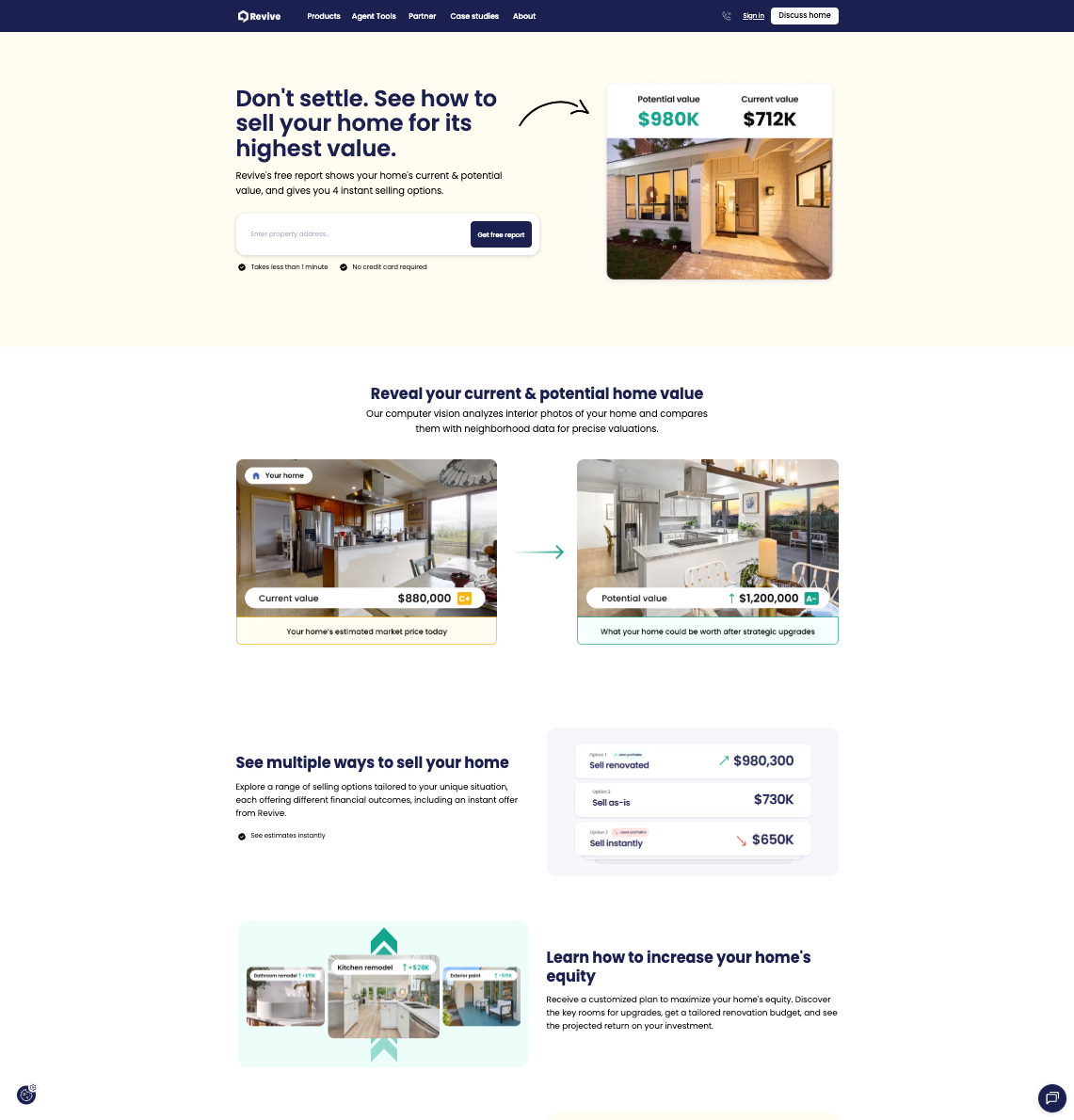
Home Analysis Report
A free report showing four selling options with projected home value after renovations. Zero friction. Instant value.
Offer 02
Sell 360 Cash Offer
Revive buys, renovates, sells — and splits the upside. For sellers who need speed and certainty.
Result
CPL dropped 85%
$230 → $35
Landing Page
Home Analysis Report: In Action
Acquisition Channels
Previously, 80% of spend was in radio — an expensive channel that was difficult to measure with no real performance feedback loop. I rebuilt the mix entirely around digital, measurable channels at ~$30K/month.
Media Mix Shift
Before
After
70%
Meta Ads
Broad targeting, lowest CPL, and the highest conversion rate of any channel. Meta gave us the ability to communicate our value proposition through video in a way search can't. Volume and efficiency in one place.
20%
Google Ads
Search exists to capture demand from people already looking. Google was expensive — higher CPL and higher cost per appointment set than Meta. We ran it to capture intent that already existed, not to generate it.
10%
Marketplace
HomeLight and Realty.com provided a floor of reliable demand. Less scalable and not a growth channel, but a steady supplemental source with minimal management overhead.
Creative Strategy
Changing the offer dropped CPL. But the creative format determined whether anyone clicked in the first place. Video changed everything.
Result
260% increase in CTR
0.5% → 1.8% average click-through rate
Video gave us something static ads couldn't: the ability to capture attention and communicate the full value proposition in the same moment. A static ad can show a home. A video can explain why selling after renovations nets you 15–20% more — and make it feel real. That combination drove CTR up 260% and compounded into every downstream metric.
Video Ad: Home Analysis
Video Ad: Grill
Static Ad: Home Analysis
Static Ad: Sell 360
Optimizing Mid-Funnel
Cheaper leads don't matter if your team can't close them. The ISA system was the bottleneck — specifically three things: how ISAs were communicating the value of the offer to leads, speed to lead, and connect rate.
Scripts by offer type
Repositioned the call: qualify seller intent, book the meeting. The renovation pitch belongs in the onsite.
Local phone numbers
Area codes matching the lead's location. Answer rates improved immediately.
10+ touch sequences
Calls, voicemails, SMS, and emails over 30 days. Most competitors stop after 2–3 attempts.
AI agent for off-hours
Calling leads within 5 minutes of report submission if they didn't self-book.
Result
2.5% → 5%
Appointment set rate — doubled
HubSpot — Re-Engage Sequence Performance
Lifecycle Marketing
Most homeowners were 3–6 months from a decision. We stayed in front of them until they were ready.
Six-month nurture campaign. Market updates, renovation ROI data, seasonal selling insights. Brings homeowners back to their report.
SMS
Drip via Sakari integrated with HubSpot. Higher open rates than email. Effective for re-engaging cold leads.
Email — Nurture Sequence
SMS — Outreach Sequence
Attribution and Reporting
Five lead sources. We were operating on a first-touch attribution model, which meant we had no visibility into which sources actually closed. We were optimizing for cheap leads — not the ones that converted.
UTM standardization
Consistent taxonomy across every ad, campaign, and platform.
Lead source capture
Every HubSpot contact tagged at creation with source, offer, and market.
Deal attribution workflow
Automated: lead source copied to every associated deal on creation.
Full-funnel dashboard
CPL, cost per appointment, and revenue by platform, offer, and market.
Deals by Offer Type — HubSpot
Deals by Platform — HubSpot
Deal Attribution Workflow — HubSpot
Final Results
$215K
Total Ad Spend
Across all channels
$35
Cost Per Lead
Down from $230
5%
Appointment Set Rate
Up from 2.5%
$614
Cost Per Appointment Set
Down from $9,200 — 93% reduction
26
Closed Deals
Across all markets
$610K
Revenue Generated
Direct attributable
Profitability Over Time
ROAS by Year
The funnel became more profitable every year as offer, creative, and mid-funnel systems compounded.
$0.30
2022 ROAS
$1.00
2023 ROAS
$1.90
2024 ROAS
$2.83
2025 ROAS
Key Takeaways
Offer and creative are key to a successful acquisition strategy.
The 85% CPL drop came from changing what we asked people to do and how we showed up in their feed. A better offer alone helps. A better offer delivered through video that actually communicates the value proposition is what moves the number.
The middle of the funnel is where revenue dies.
Cheaper leads only matter if someone can close them. Fixing how ISAs communicated and building the infrastructure around them is what turned volume into revenue.
Attribution has to go all the way to revenue.
Some of our cheapest lead sources had the worst downstream conversion rates. Full-funnel reporting let us optimize for revenue, not vanity metrics.
What I Would Do Differently
Hire a creative producer in year one.
Video creative turned out to be one of the biggest performance levers we had — driving CTR from 0.5% to 1.8% and compounding every downstream metric. We didn't bring a dedicated creator on until mid-2024. If I ran this again, that hire happens at the start. The earlier you have someone who can produce native-feeling video at volume, the faster everything else compounds.